
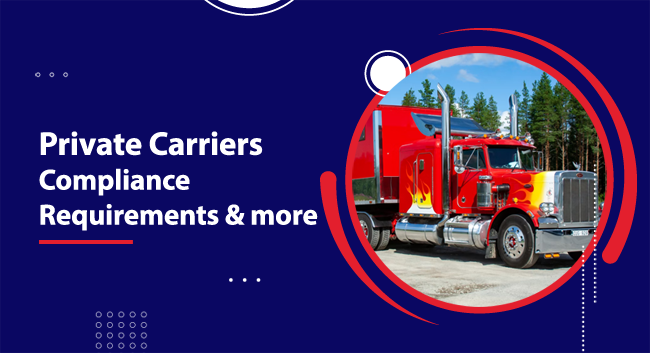
If you are a private carrier and you want to cross state lines to do business, there are certain regulations, compliance requirements, rules, legal formalities, and protocols that you must follow and comply with.
Private carriers that intend to haul their own products across state lines do not have to register for federal motor carrier authority or ICC authority or trucking authority.
However, if you want to cross state lines, you should register for a USDOT number right away. You should also enroll yourself in the Unified Carrier Registration program and should register for an IRP license plate as well. The IFTA fuel tax regulation is also going to apply to you.
You have to register for the federal MC authority if you are a private carrier who transports own products across state lines or returns with the items/loads you get paid for to transport regardless of the weight.
It is regardless of the fact whether you’re working for hire or not. Now the only additional costs that you have to bear are those of registration.
Pick-Up Truck Pulling A Trailer Transporting Nonhazardous Materials
If you are a private carrier and want to transport your own products across state lines using a pickup truck or a van while pulling a trailer and if the combined gross vehicle weight rating turns out to be 10,000 lbs or a little less than that, you are not required to register for a USDOT number.
The same applies to the van and the trailer and the entire transportation setup. You also do not have to enroll in the Unified Carrier Registration program. In addition to this, you do not have to apply for an IRP license plate or get your IFTA fuel tax registration done.
Pickup Truck Not Pulling A Trailer Transporting Nonhazardous Materials
The private carriers that haul any products across state lines using their vans or pickup trucks and have a gross vehicle weight rating of 10,000 LBS or less than that are not required to register for a USDOT number.
If the GVWR of the pickup truck or van is 10,000 LBS or less than that, you may not register for UCR and are not required to apply for an IRP license plate or IFTA fuel tax registration.
Transporting Hazardous Materials Using A Van Or Pickup Truck By Itself And/Or Pulling A Trailer
Private carriers that intend to transport hazardous materials either with a van or a truck regardless of the weight of the entire setup or with a van or a truck pulling a trailer regardless of the weight combination should acquire a US Dot number and must also register for hazardous material transportation.
They don’t have to register for the Unified Carrier Registration program and the IRP license plate or to register for IFTA fuel tax is not necessary.
However, if as a carrier, you intend to transport hazardous materials that require placarding, you must register for hazardous materials transportation with your home state.
Transporting Hazardous Or Non-Hazardous Commodities While Pulling A Trailer With A Pickup Van Or Truck
This compliance requirement applies to the power vehicle and the trailer that when combined have a gross vehicle weight rating between 10,000 LBS and 26,000 LBS. In such a case, you need to apply for a USDOT number.
However, you do not have to apply to The UCR program if the GVWR of the power unit alone is less than 10,000 LBS. You do not have to apply for an IRP license plate or even for an IFTA fuel tax registration.
You will require a US DOT number and also Unified Carrier Registration if you are driving a pickup truck that has a GVWR between 10,000 LBS and 26,000 LBS. It applies to you when you are driving a truck with a GVWR of 10,000 LBS or more.
The same applies to a pickup truck or any kind of truck that has a GVWR of over 10,000 LBS in addition to when it is pulling a trailer with a GVWR of the trailer and power unit combined. You do not require an IRP license plate or registration for IFTA fuel tax as well.
Driving A Truck With Three Axles
If you are driving a truck with three axles regardless of its weight or pulling a trailer with this truck at any weight combination you will have to apply for a USDOT number.
You must also register for the Unified Carrier Registration program. Your truck must have an IRP license plate as well as registered for IFTA fuel tax.
You must meet the US DOT number and UCR registration requirements if you are driving a truck that has a gross weight of more than 26,000 LBS.
The same applies to a semi-tractor and trailer combination that has a gross weight of more than 26,000 LBS. You will need an IRP license plate and must register for your IFTA fuel tax filing as well.
All of this can be simplified if you have a dependable and highly reputable third-party DOT compliance facilitator.




0 Comments