Blogs

June 1, 2022

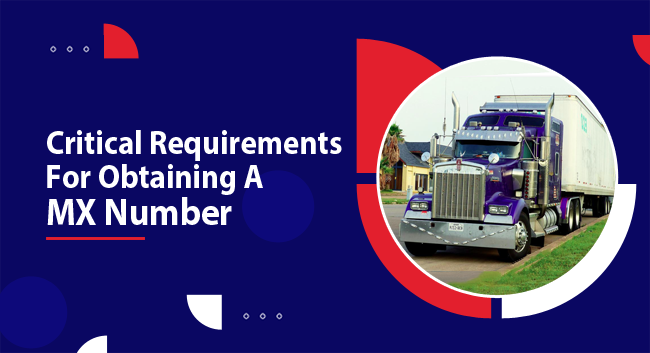
Guide to Securing Your MX Carrier Number Now

If you are a trucking company/carrier and want to understand the cross-border operating requirements for Mexico-domiciled motor carriers, you have come to the right place. The following section should be able to answer all your queries including how to get an MX number and what the requirements and process for MX number application are. Let’s begin:

What Is MX Number And What Is Its Importance?

The Form OP-1(MX) is used to apply for or register for the MX number. According to the FMCSA, it is mandatory for every Mexican carrier company to register for the relevant Motor Carrier Authority if they want to operate in the US and beyond its many municipalities and commercial zones. If you as a Mexico-domiciled motor carrier are in the process of applying to the FMCSA with a Form OP-1(MX), you must not have a conditional or unsatisfactory safety rating from the USDOT or your application will be rejected.

Who Needs A MX Number?

If you are a Mexico-domiciled motor carrier and want to enter the U.S. to do business, you must have an FMCSA-assigned MX number. This is a necessary document that the FMCSA issues. It is equivalent to a certificate of registration or you can consider it as an operating authority of sorts that allows you to operate in the US. You must also have a valid USDOT Number along with it.

How To Get A MX Number – In A Gist

Understanding Your MX Number And Your Certificate Of Registration Along With US DOT Number

It is going to take you a little bit of time to obtain your MX number or operating authority. It depends on the application that you have submitted. You can obtain your US DOT number online quite easily. You will have to submit a complete application form for the purpose. It will take around 4 weeks to get issued. There is also a thing called long-haul operating authority registration which is your OP-1 MX number (more on this later). Your application should take at least 4 to 6 weeks to get processed.

MX Number Requirements – A Brief Overview

If you are a Mexico-domiciled motor carrier, you will need an MX number in case you decide to cross the U.S. border.  If you don’t have this, you can apply for an FMCSA Certificate of Registration or an Operating Authority and also a USDOT Number.

MX Number Application Process – Things You Should Be Aware Of Before You Apply For It

  • As a carrier, you must submit to and pass a pre-authorization safety audit. When you have completed it successfully, you will be notified of the results. There will be a few requirements that you will have to fulfill while submitting proof of evidence to the federal motor carrier safety administration.
  • After this, the carrier information will be published in the FMCSA register. There is also a 10-day protest period that follows after this and at the end of this period, after your BOC 3 designation of process agent form submission; you will be issued a provisional authority.
  • Make sure that you submit a correctly filled out MX number application only. If it is not filled out correctly, it will be returned to you to make corrections. 

Operating Without Authority? Understand The Repercussions

If you are operating without your MX number or authority, you will be most likely put out of service. As a carrier company, you will be subject to certain fines and penalties as well.

Waiting For Your Certificate Of Registration For Commercial Zone Operations

Yes, you will have to wait for this certificate. If you are a Mexico-domiciled motor carrier, you will have to be there to receive your certificate of registration for commercial zone operations. This is also your provisional operating authority registration for all your long-haul operations. This authority is going to take you beyond your commercial zone. You can only operate in the United States when you have received this documentation from the federal motor carrier safety administration.

Changing The Type Of Authority You Have – For Mexico-Domiciled Carriers

After you obtain your MX number and your operating authority or certificate of registration, you are required to submit a new OP-1 (MX) form or an OP-2 form/application and also pay a fee to obtain a new or change your operating authority.

So these are a few requirements that you should take care of when applying for your Mexican carrier number.

FAQ

Who Needs a USDOT Number?

Businesses that run commercial vehicles weighing more than 10,000 pounds—whether carrying passengers or moving freight—are required to register with the FMCSA and obtain a USDOT number. This number serves as a unique identifier that allows federal regulators to track and review a company’s safety records.

How Much Does a USDOT Number Cost?

Acquiring a USDOT number is free when processing with the FMCSA. For a hassle-free process with one-on-one assistance, visit: https://dotcompliancegroup.com/usdot-number-application-form/ or call 972-232-2218.

What Documents and Information Are Required?

To obtain a USDOT number, you will need to provide your business and operational details and identification. This includes legal business name, physical and mailing address, contact information, EIN number and/or SSN, type of business, cargo/cargo type, and operating authority.

How Long Does It Take to Get a USDOT Number?

Applying for a DOT Number can be done as fast as a few minutes. To obtain your DOT number today, visit: https://dotcompliancegroup.com/usdot-number-application-form/ or call 972-232-2218.

What if I renewed my UCR with DOT Compliance Group last year?

If you renewed with us last year, please check your Customer portal. If auto-renewal is still active, your UCR will automatically renew. If you have turned off auto-renewal, you’ll need to submit your renewal here on this page.

If I Pre-Register for 2026 UCR, when will I be charged the total amount?

The total amount will be charged on October 1, 2026 for the 2026 year.

I am an Ag Exempt Farmer. Am I exempt from registering for UCR?

No, if you cross over state lines you are required to register for UCR. Your Ag exemption does not apply to UCR.

If I am an Amazon or Postal Service Contractor do I have to register for UCR?

Yes. Even though you do not cross state lines, your parcels do. That makes you an Interstate carrier and you would be required to register at the 0-2 fleet size.

Who is Exempt from UCR?

Private Motor Carriers of Passengers and All Motor Carriers operating solely within Hawaii, except those involved in moving household goods for individual shippers.

What states do not currently participate in UCR?

Currently Arizona, Florida, Hawaii, Maryland, Nevada, New Jersey, Oregon, Vermont, Wyoming, & the District of Columbia are non-participating states. (This information is current as of 6-16-2023. For the most up-to-date information check the FMCSA website.)

If my base state is a non-participating state that means UCR does not apply to me, correct?

No, if you operate as an interstate carrier and cross into a state that does participate, then you are required to register with UCR.

Who must comply with DOT regulations?

Any business operating a Commercial Motor Vehicle (CMV) with a USDOT number is required to comply with DOT regulations. This requirement applies to motor carriers, freight forwarders, brokers, and companies operating under a hazardous materials permit.

What documents are required for a DOT audit?

Documents required during an inspection include but may not be limited to:

  • State driver’s license or commercial driver’s license
  • Medical examiner’s certificate
  • Record of duty status
  • Vehicle registrations
  • Periodic inspections document for all vehicles being operated
  • Shipping papers or bills of lading
  • Information for hazardous materials being transported
  • Proof of insurance

How can companies avoid common DOT violations?

Companies can avoid common DOT violations by maintaining accurate records, including driver logs, vehicle inspections, and required documents. Regular vehicle maintenance and pre-trip inspections help prevent safety-related violations. Proper training ensures drivers follow Hours-Of-Service rules, secure cargo correctly, and meet CDL and medical requirements. Using technology like ELDs and fleet management software can streamline compliance and reduce the risk of penalties.

What happens during a DOT compliance review?

During a DOT compliance review, or audit, officers review both the vehicle and the driver to ensure compliance with federal and state regulations. They check registration, insurance, inspection reports, and inspect safety equipment and vehicle systems for proper operation. Drivers’ licenses, medical cards, hours-of-service records, and logbooks or ELDs are also examined. The inspection helps identify violations and ensure safety on the road.

0 Comments

Submit a Comment