
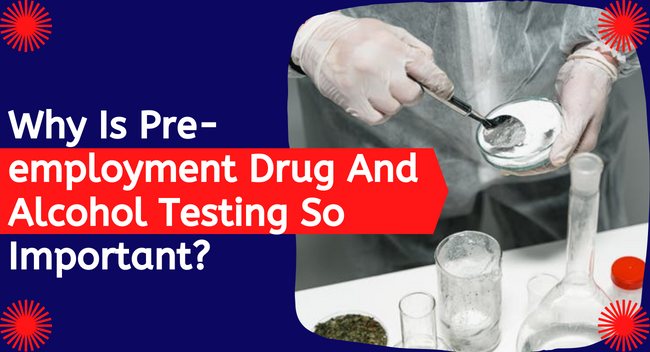
Pre-employment drug and alcohol testing has gained importance and relevance not just across the transport sector but in many industries. Employers across domains want to make enterprises safer for everyone.
Yes, the biggest purpose of these tests is to improve workplace safety and you would agree that these measures do play a vital role in it. You would also agree that there are several preventive services available to employers that help them achieve their goals. They can take advantage of them to enforce strict workplace norms and improve overall safety.
For example, hospitals, clinics, and even airports had encouraged the use of personal protective equipment (PPE) kits for numerous purposes during the virus breakdown. This included training, working, commuting, and worksite risk analyses. The same applies to the trucking industry as well.
Pre-employment screening/ drug and alcohol tests are a cost-saving, preventive measure that can easily help an organization reduce its costs significantly.
It doesn’t just help them decrease their medical costs, but also regain their lost productivity, reduces absenteeism, controls increased health care costs, and does a lot more to control drug and alcohol use and abuse.
What Is A Pre-Employment Drug Test?
You can use a pre-employment drug and alcohol test to determine if a driver or a candidate for a critical position or a safety-sensitive job or any prospective employee for hire uses any illicit substances or abuses their prescription medication.
You can also use the same tests and assessments for employees who want to return to work after testing positive at their random drug test or an injury or absence. At that time, it may be referred to as a pre-placement drug test.
It is very common for employers to make this requirement mandatory for any candidate along with pre-employment background checks as well. The employer must administer a pre-employment drug test, and they will determine whether to give or withdraw the job offer based on the results of the test.
These tests are typically carried out to screen the following illegal substances:
- THC (cannabinoids, marijuana, hash)
- Methamphetamines (meth, speed, crank, ecstasy)
- Phencyclidine (PCP, angel dust)
- Cocaine (coke, crack)
- Opiates (heroin, opium, codeine, morphine)
Drug Testing Specimen Types
- The DOT prefers to use urine, hair, blood, and saliva as drug testing specimen types.
- Urine seems to be the most common choice because of its accuracy and it is mandated for regulated drug tests.
- But because urine testing has a rather short window of detection, the preferred types in its place in many situations are saliva, breath, blood, and the most expensive one, hair.
- Any prohibited or illegal substances can be easily detected for 5 to 10 days in urine. However, when you talk about hair drug tests, these substances can be detected for up to 90 days.
- Employers also go for blood testing because it is highly accurate. It could be a little bit costly and it is invasive, so you may have trouble with some employees consenting to it. Another demerit of it is that it has a much shorter detection period which can be minutes to hours.
- A saliva test also has a much shorter detection period which can be anywhere between 7 and 21 hours. It is also known as an oral fluid test. Employers prefer to go for a saliva drug test in conjunction with a urine sample frequently. This practice is highly effective when wanting to avoid issues that arise out of an employee not being able to provide sufficient urine.
Rationale Behind Choosing Pre-Employment Drug And Alcohol Testing For Your Employees
Workplace Safety
Many employers have understood the importance of workplace safety. Conducting pre-employment drug and alcohol tests is one of the most efficient ways to mitigate risks associated with incidents of alcohol and drug misuse.
On a job application, they indicate that the candidate must appear for this test, and only offer a letter of employment upon testing negative.
This way, the employer can help deter substance abusers or unsuitable candidates from applying for the job altogether.
Reduce Expensive Workers’ Compensation Claims
For every occupation that requires an employee to be alert and more diligent such as in a safety-sensitive environment, pre-employment drug and alcohol testing is highly critical.
It can also reduce the rising number of expensive workers’ compensation claims that involve drug or alcohol use. So, as an employer, you stand to benefit a lot from this test. Also, according to various studies done by the National Institute on Drug Abuse:
- Drug use results in almost a five-fold increase in workplace injury claims
- Close to 50% of all workers’ compensation claims made throughout the year are of workplace substance abuse
Manage Workplace Productivity And Absenteeism
- Substance abuse and resultant impairments result in 3.5 times more accidents at the workplace
- Excessive substance use and resultant impairments increase the probability of an employee missing 8 or more workdays in a year by 2.5 times
- Substance abuse may contribute to a decrease in company productivity by 33%
Understand The Legality Of Pre-Employment Drug Testing
The legality of drug and alcohol testing before employment commences evolves from state to state. Trucking companies can consult with their third-party administrators and legal counsel if they have any doubts or questions.
They should also speak at length with them about implementing a random drug and alcohol testing program in their organization. They also need to discuss their testing program’s compliance as per state regulations.
In addition to that, they must follow some general best practice guidelines. These may include the following:
- They need to ensure that the applicant knows beforehand about the pre-employment drug and alcohol test being a part of their new employee screening process
- All applicants for the same/similar jobs must undergo the same/similar types of alcohol and drug tests
- Drug tests should always be administered at a state-certified laboratory only
Final Thoughts
So, you know much about drug and alcohol testing before employment commences. It is time to consult your third-party administrator/ DOT compliance consortium for more information. Stay informed. Stay compliant.





0 Comments