
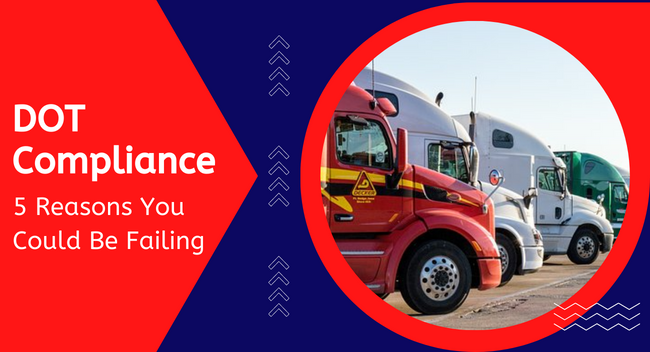
According to recent statistics, only 7% of the carriers that are audited by the department of transportation pass the DOT compliance audit without any violation at all. Now, this is a very startling number and you would want your company to be a part of that 7%. Those carriers that fail to pass this audit usually make very common and silly violations that can be easily avoided. But when they do end up making these mistakes, they have to bear the brunt of their carelessness. There are fines and penalties in place that they have to pay and the result is that the reputation of their company gets a negative impression in the market. And the worst part is that it adds up really fast. When the word goes out in the market, it spreads like wildfire and that further impacts your business negatively and it becomes very difficult to get out of that vicious circle.
What Do You Do?
You make efforts to understand what the most common violations are that you might be prone to making. You also take care of the many rules and regulations that you have to follow regularly and make sure that you do not miss any deadlines at all. Let’s have a look at a few factors/violations that are easily avoidable but can make you fail at DOT compliance:
1. Forgetting To Perform Background Checks
As a carrier, it is your responsibility and duty to perform background checks on all your existing drivers and any prospective safety-sensitive position holders that you want to hire in the future. You must also get access to the records of any past accidents and violations that they may have been a part of. Background checks also include drug and alcohol testing history and the employee’s alcohol and drug test statement in addition to information that you can get from the previous employer of the driver. The FMCSA is going to consider forgetting to perform a background check on your driver a very serious violation.
2. Don’t Know How To Use The FMCSA Clearinghouse?
This brings us to a very critical requirement that you must fulfill which is of the FMCSA clearinghouse. The most appropriate way to conduct background checks on your employees and drivers and also to get all the critical information about their previous work record and any drug and alcohol use and abuse history is to query the FMCSA clearinghouse once every year. The clearinghouse is a very secure online database that contains all the information about commercial driver’s license holders regarding their drug and alcohol violations. If they have had any positive drug or alcohol test results including test refusals and other critical information, all of this would impact your decision to hire them. This and more data are recorded in this database. Conduct a limited query every 12 months to fulfill this requirement.
3. Not Coming Up With A Random Testing Process For Your Company
If you haven’t come up with a random drug and alcohol testing procedure for your employees, it is time to get in touch with your third-party administrator and get it done right away. The US department of transportation requires all employers to carry out a random drug and alcohol test every year. You should test 50% of your CDL drivers for drug use and abuse in the workplace. The next requirement is to test at least 10% of them for alcohol use every year. The selection should be completely random which means that there is a high probability that any of your drivers can get selected. This puts them in a spot and that is good because it encourages them to stay sober whenever they are handling any safety-sensitive job responsibilities or operating any vehicle. Not having a random testing process in place is a very serious violation because it puts everyone’s safety at risk.
4. Inability To Understand DQ Files And Related Practices
Your inability to understand and/or manage your driver qualification files is also one of the reasons you could fail in your DOT compliance. If your DQ files are out of date or if they haven’t been updated regularly, it is going to reflect badly on your compliance record. Every employer that hires CDL drivers must maintain their DQ records regularly. This driver qualification file should include specific information such as:
- Certificate by a medical examiner
- Application for employment by the driver
- Enquiry to previous employers regarding safety and performance history
- Road test and completion certificate of the driver or any equivalent
- Background screening report
- Pre-employment drug test
- On-duty hours record
- A copy of the license of the driver and other license information
- Certification of compliance
5. Allowing A Prohibited Driver To Operate A CMV
This is a very serious mistake and a big violation that you should always avoid. You might find that an ineligible driver has been appointed to perform certain safety-sensitive job responsibilities in your workplace. It is better to assess their safety and performance history before you allow them to operate any critical machinery. As an employer, you must be vigilant and make sure that they have a valid driver’s license and that their record is absolutely clean. If a driver operates machinery or a commercial motor vehicle after having their license revoked or suspended, it can result in serious problems for your company. You might be subject to several fines and penalties. Your operating authority might get impacted negatively. The FMCSA might prohibit you from performing several of your business operations for an indefinite period of time.
Final Thoughts
Do you know that last year these violations accounted for more than 30% of all violations across the country? The average fine that was levied on all the carriers and organizations amounted to a little more than $8,000. Now that is a big figure. You don’t wish to pay that out of your pocket. The best way to avoid these complications and the eventual financial injury is to associate with a third-party administrator that understands your company and its DOT compliance needs the best.




0 Comments