
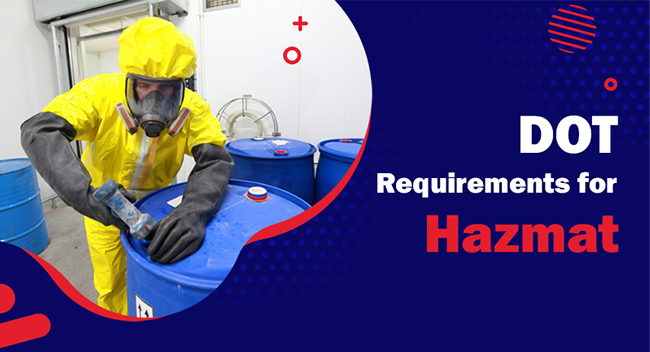
When it comes to the transportation of hazardous materials, the United States Department of Transportation (USDOT) and Federal Motor Carrier Safety Administration (FMCSA) have defined the national requirements under an act known as the Hazardous Material Transportation Act (HMTA). These requirements apply to every state in the US and there are authorities put in place to enforce the compliance of the rules and regulations.
Therefore, if you own a company that is into the transportation of hazardous materials (Hazmat), in addition to getting your USDOT number, it is necessary to obtain a Hazmat Transport Permit. Whether your business involves transporting hazardous materials via interstate, intrastate, or foreign transportation, you need to get a safety permit to operate legally. Why is it essential to get a safety permit? It is to the safety of motor carriers on the highway. Also, since you are dealing with hazardous materials that have the potential of causing death or causing havoc to the environment, there is a need for every company involved in Hazmat transportation to file for a Hazmat Transport Permit.
While it may look quite difficult filing your documents for the Hazmat Permit, DOT Compliance Group can make the process seamless for you. With our professional agents, all your paperwork will be handled effortlessly, and you won’t have to border on your Hazmat Permit.
What Is Considered as A Hazardous Material?
According to FMCSA, a hazardous material (Hazmat) is any substance that is transported and has the potential of affecting one’s health, causing havoc to the immediate surrounding, or even leading to the loss of lives and properties. Therefore, if you are involved in the commercial transportation of materials that can potentially be harmful, you need to do the proper filing according to the Federal Hazardous Materials Transportation Act.
What Does It Mean to Have A Hazmat Safety Permit?
A permit is something that officially allows you to do something. Therefore, having a Hazmat Safety Permit means having the permission to transport hazardous materials either interstate or intrastate. As an employer or owner-operator of a transport company that deals with Hazmat, it is officially illegal to operate without obtaining a permit from the relevant agencies.
Who needs to get a Hazmat safety permit? If your business falls within any of the categories below, you need to file for a safety permit.
- If you carry a highway route-controlled quantity of class 7 material (radioactive materials).
- If you carry more than 25kg (55lbs) of explosive materials classified as Division 1.1, 1.2, or 1.3, or an amount of Division 1.5 that requires a placard.
- If you carry over 1 liter per packaged material termed “toxic by inhalation in hazard zone A”.
- If you carry materials in bulk packaging greater than 450L (119 gallons) or greater than 454kg (1000lbs) that are termed as “toxic by inhalation in hazard zone B”.
- If you carry materials in bulk packaging 3,500 gallons or more termed “toxic by inhalation in hazard zone C or D”.
- If your business is involved in the shipment of liquid methane or natural gas with methane content of at least 85% in bulk packaging with capacity of 3,500 gallons or more.
Applying for a Hazmat Safety Permit as a Motor Carrier
To apply for a safety permit, you will need the following:
Application Form
As a motor carrier, to apply or renew your safety permit, you need to complete the Hazardous Material Permit Application and submit Form MCS – 150B. Peradventure you don’t have a current DOT number, you will have to also submit MCS – 150 Form. For a new entrant, you will need to also submit MCS – 150A.
Where and how to get the application form and necessary instructions?
To obtain the application form, you need to visit the official website of FMCSA: www.fmcsa.dot.gov or you can contact FMCSA directly through the phone.
Signature & Certification
As a motor carrier, you must ensure to go through the form properly to confirm all the information is correct. Making a mistake might get your form rejected and you will need to start the process again.
Updating your information on Form MCS – 150B
As a motor carrier with a safety permit, you must report to the Federal Motor Carrier Safety Administration in writing in case you make any changes on the Form MCS – 150B, within thirty days of the change.
You might need help when filing for a Hazmat Safety Permit!
While the process of applying for a Hazmat Safety Permit might look simple to execute, the process can be time-consuming and frustrating. For you to file for the Hazmat Safety Permit, you must ensure that no mistakes are made and the information provided is accurate. Making any mistakes will get your form rejected and this could affect your business operations.
Simplify the process of obtaining a Hazmat Safety Permit with the help of the DOT Compliance Group. Our team of experts specializes in assisting motor carriers, ensuring a smooth ride towards permit acquisition. Leave the paperwork to us, allowing you to focus on other vital aspects of your business.
The consequences of Hazmat Permit Violations
If you are into commercial transportation of Hazmat, you probably don’t want to violate the rules because the consequences are severe. From our observation, it seems the United States Department of Transportation usually increases the civil penalties for anyone who fails to comply with its regulations.
Below are the new civil penalties for anyone who fails to comply:
- For hazardous material shipping violations, the maximum penalty is $83,439 for each violation per day.
- If for any reason, your violation resulted in severe illness, huge loss of property, or death, you will pay $194,691 for each violation per day.
- Lastly, if you fail to provide proof of hazardous training for your employees, you will pay $502 for each employee per day.
You must also bear in mind that apart from providing training to your employees, you need to document the training. Not documenting training can get you penalized. All training must be kept for future reference. The essence of the training is to enlighten your employee on what to do to prevent accidents that could lead to loss of lives and properties.
DOT Compliance Group is Always Available to Help!
Whether you are interested in Hazmat registration, Hazmat Permit, or Hazmat training, putting a call through to us now is what is needed of you. Over the years, we have been offering exceptional services to motor carriers all over the United States. We are experts in handling DOT compliance issues and we have helped thousands of motor carriers to stay compliant with the rules and regulations of USDOT and FMCSA.
Get in touch with us today through our phone number: 972-402-5456 or via email: support@mcs150complian.wpenginepowered.com and we will be glad to render our services to you.




0 Comments