
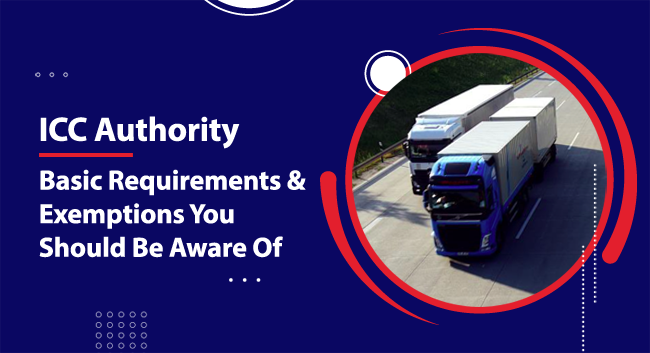
What is Interstate Commerce Commission Authority
If you are working as a “for-hire” carrier and intend to haul loads across state lines in exchange for pay, most of the loads that you want to haul will require you to obtain an ICC authority from the federal government in Washington.
You will require this ICC authority if you are hauling loads in a van, in a pickup truck towing a trailer, a pickup truck alone, or a straight truck, or a straight truck that tows a trailer or a semi-tractor and a trailer combination.
Regardless of what vehicle apparatus you choose, you will need ICC authority to cross state lines. You will have to take into consideration the gross vehicle weight rating of your vehicle in this application. The GVWR of the power unit and the trailer will also be considered.
The GVWR or the CGVWR, if below 10,000 LBS in your application for ICC authority, you will have to get at least $300,000 in personal injury or property damage liability insurance.
If the GVWR of the vehicle or the CGCWR is greater than 10,000 LBS when you apply for your authority, this requirement is going to change to $750,000 in personal injury and property damage liability insurance.
MC authority is the official name of the ICC Authority. Remember that in this process of applying for your ICC authority you will also need a USDOT number.
You are required to keep your PIN handy for this application as well if you already have your USDOT number.
Exemptions Do The ICC Authority Requirements
Yes, there are a few exemptions that you should be aware of. These include the following:
Farmers With Farm Plates
You will not have to apply for ICC authority if you are a farmer using a vehicle with a farm plate. Even if you intend to cross state lines, you do not have to apply for this authority.
Whether it is a farm-plated van or a pickup truck or any other vehicle, you do not have to apply for a USDOT number or register for Interstate Commerce Commission authority.
This applies to automobiles with a GVWR of 10,000 LBS or less and also a CGVWR of the same value.
However, if the gross vehicle weight rating of your vehicle setup is more than 10,000 lbs, you will have to apply for a USDOT number. An Interstate Commerce Commission authority will not be required.
When your semi-tractor, trailer, or trailer tractor combination has a gross vehicle weight rating of more than 10,000 lbs, a USDOT number is required but not an ICC authority.
Your farm-plated truck or trailer or any apparatus that pulls a trailer exceeds the weight of 26,000 lbs when you are crossing state lines, you must register with the state for IFTA fuel tax.
To cross state lines using a farm-plated semi-tractor or a trailer, you must register for a US DOT number and IFTA fuel tax. However, you do not need to obtain ICC authority.
Private Carriers Involved In Hauling Their Own Products
When it comes to private carriers, they do not need to have Interstate Commerce Commission authority.
If your business entity or manufacturing involves hauling its own products across state lines using a vehicle with a gross vehicle weight rating of 10,000 LBS or less, you do not need to obtain a USDOT number or register for ICC authority.
This is also applicable if the CGVWR is less than 10000 LBS. If the vehicle that you are using to cross state lines has a GVWR of more than 10,000 LBS whether it is a truck or a semi-tractor or a semi-tractor pulling a trailer, you will require a US DOT number but not ICC authority.
“For-Hire” Carriers Involved In Hauling Exempt Products Across State Lines
In this case, you still don’t need ICC authority. If you are hauling exempt commodities across state lines and these include logs, corn, and livestock, you do not need ICC authority.
If the GVWR is less than 10,000 LBS, you will require neither a US DOT number nor ICC authority.
When your truck has a GVWR of more than 10,000 LBS and a power unit of CGVWR of more than 10,000 LBS. You then have to apply for a US DOT number but not ICC authority.
ICC Authority Requirements When Applying For It
When you are applying for your ICC authority, you will need to have your US DOT number as well. You must also register for the BOC-3 list of process agents. Remember to carry personal injury or property damage liability insurance as well.
Your authority requires you to have adequate cargo insurance to cover the value of the cargo that you are carrying.
When you are applying for the authority, remember that the entire process is going to take at least 21 days.
The feds will issue you a docket number and grant you final authority only after verifying that you have submitted all the correct information.
When you get your authority and a letter of ICC authority, then you need to keep these documents with you in your vehicle.
After you get your final authority, you will have to register for the Unified Carrier Registration program. After that, you have to go through a new entrant carrier safety audit process.
There will be 16 requirements that you will have to fulfill. If you fail even one of them, your authority will be taken away.
A state police officer from the motor carrier section will visit your workplace to conduct the safety audit. Make sure that you follow the 16 critical guidelines to the last detail to retain your ICC authority.




0 Comments