
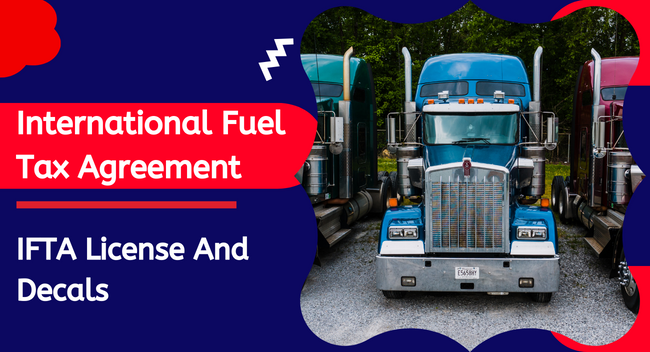
Understanding IFTA: What It Is and Why It Matters
IFTA is the short form for an International Fuel Tax Agreement adopted in 1996. According to this agreement, commercial carriers and drivers need to pay the Fuel Taxes across all the states they are traveling.
Regardless of where they purchase the fuel, they must pay these taxes. Each state across the country has its own IFTA requirements. That means they will charge their fuel tax and pay to the relevant state or province.
Before the IFTA came into existence, every carrier needed to register in every state that they entered. They had to stick decals on their vehicles which were proof that they had already registered in that state.
The trucking company would take on the responsibility of ensuring that the proper fuel tax amount was paid to the respective state or province. They would also have to make sure that proper refunds were collected. IFTA simplified the entire process.
Right now, 48 American states and 10 Canadian provinces are the participants of this agreement. If as a carrier, you obtain a single IFTA license for your vehicle, you are good to go and allowed to travel across all the IFTA jurisdictions. Just submit one quarterly fuel tax return and that’s it.
IFTA License and Decals: Key Considerations to Keep in Mind
- With the help of the IFTA license and decal, the payment of fuel taxes to multiple jurisdictions becomes more simplified and much faster
- If as a trucking company or motor carrier, you operate across two or more states, you will be subject to the IFTA license requirements
- You can simplify IFTA reporting even further by associating with a reliable and trustworthy third-party administrator.
Are You Eligible for an IFTA License and Decals?
If your motor vehicle has been built and is being used to transport property or people in addition to the following, you are going to qualify for an IFTA license:
- Vehicle has two axles and if the gross vehicle weight is more than 26,000 lbs
- The vehicle consists of any part that has 3 or more axles
- Vehicle used in combination and the resultant weight is more than 26,000 lbs
- If you are a motor carrier that drives or operates the vehicles described above, you will require an IFTA license
- If you are based in an IFTA member state or province and operate across two or more member states you will require this license
How Should You Apply For The IFTA License And Decals?
You can obtain your IFTA license and decals very easily online. But as an alternative, a more stress-free way to do it is by getting in touch with your third-party administrator. They will be able to determine whether your company requires an IFTA license or not.
They will fill up the IFTA application form on your behalf and administer it by the Department Of Transportation or the tax collection agency of the state you live. If you need to apply for additional decals and make account changes, you can do that with the same form.
IFTA License Application: What Documents and Information Are Required?
- Your USDOT number
- Registered business name
- Mailing address
- Federal business number
Your provincial or state IFTA Authority is going to issue you your IFTA for the current year as soon as your IFTA license application is processed. Until that time, you will have to hold on to the temporary license that you will receive by fax from the authorities.
Understanding the Validity of Your IFTA License
Your IFTA license and decals are going to expire every year on 31st December. You will have until the first of March of the following year to obtain your new IFTA license.
Do You Need More IFTA Decals?
The IFTA issues two decals to a trucking company or carrier for each licensed vehicle they have, and they must display one decal on each side of the truck cab.
Once you receive your license, file a quarterly international fuel tax agreement return on every due date. The deadlines for the same or as follows:
- 1st quarter (Jan. to March)—April 30
- 2nd quarter (April to June)—July 31
- 3rd quarter (July to Sept.)—Oct. 31
- 4th quarter (Oct. to Dec.)—Jan. 31
In addition, you have to track the miles traveled in every state. Encourage your drivers and fleet managers to work together and ensure that they know the exact amount of fuel consumed across each state and province. The details need to be accurate and recorded without fail.
Also, record the odometer readings in addition to fuel purchased in every state. This consists of the total gallons of fuel that they have purchased in every province. They may retain the original receipts and invoices as proof of purchase and must also calculate the total miles per state. They should also calculate the number of miles for every jurisdiction that they have travelled through.
The easiest way to do that is to hand over all your records, receipts, invoices, and readings to your DOT third-party administrator. They will do the needful and also calculate the tax return that needs to be filed every quarter.
Final Thoughts
So, these were a few things about the international fuel tax agreement and decals that you should always be aware of.
For more information, you should connect with your third-party administrator or DOT compliance facilitator right away. They help you stay compliant throughout the year.




0 Comments