
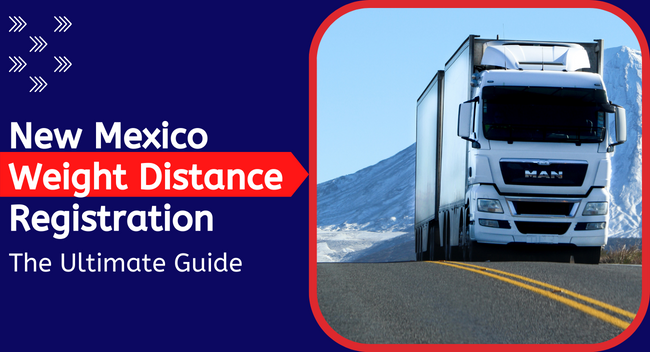
There is a lot to be known and understood about the New Mexico weight distance tax registration. The registration process for it is simple but it applies only to a few categories of vehicles. New Mexico has a weight distance tax just like any other tax that you are required to file annually or quarterly to stay compliant with the rules and regulations laid down by the FMCSA and USDOT.
New Mexico imposes this tax on all motor vehicles that have a weight of more than 26,000 lbs. If these vehicles travel in New Mexico, they will have to purchase a trip permit at the border or file their weight distance tax regularly. The tax rate is primarily based on the gross weight of the vehicle that is registered with the authorities. The weight of the vehicle is listed on the permit. The miles that you buy at the port of entry are then deducted from the quarterly return that you file.
If you are a registrant, owner, or operator of commercial vehicles that have a gross weight of more than 26,000 pounds, and if you intend to use highways in New Mexico, you will be subject to the weight distance tax. Under section 7-15A-3 NMSA 1978, you are required to file and pay this tax on time.
This is a quarterly tax which means that for the quarter that starts on January 1st and ends on March 31st, you will have to make the payment by April 30th. Even if you have not traveled through New Mexico, as a carrier, it is your responsibility to file a return. If your return is due after August 1st, 2010, you are required to pay taxes for two or more trucks. It is better to file your return electronically using the method recommended by the state.
You are also required to submit a confirmation for the electronic filing of your return. If you have not received any confirmation, you can submit your tax identification number along with the payment. This is because if you do not submit the confirmation or the tax identification number, the payment may not get applied to your account properly. This can result in penalties and interest which is not good for your reputation.
It is highly recommended that you let your DOT compliance facilitator perform this activity for you or on your behalf. It frees you of repetitive and mundane responsibilities so that you can focus on your core competencies and business functions instead.
Securing A New Mexico Weight Distance Permit As A US Trucking Company
Yes. Several US trucking companies are required to apply for a New Mexico weight distance permit. This is because the state of New Mexico has a weight distance tax that applies to motor vehicle operators, owners, and everyone involved in the transport sector. Regardless of whether you work in interstate commerce or intrastate commerce, you must file this tax. This tax factors in the miles traveled across New Mexico roads by you and also the weight of your vehicle. You must register for this permit every year. One permit is valid for one vehicle in your fleet. You must fulfill this requirement if you want to continue to do business in New Mexico.
New Mexico Weight Distance Permit/Tax – Understanding The Basics
DGVW stands for declared gross vehicle weight. If you are operating a vehicle on New Mexico Highways with a DGVW of more than 26,000 pounds, you will have to pay, register for, and report your weight distance taxes quarterly. If you do not wish to do this, you will be subject to the trip tax. This tax is going to apply to you every time you enter or leave the state of New Mexico.
If your vehicle has a title in New Mexico and if it qualifies for this tax in a situation where it travels only intrastate, it must have a weight distance plate on it. But if you travel interstate, you must use an IRP plate instead. If you are subject to the NMWDT, you will have to file your tax return every quarter.
Do You Qualify For A New Mexico Weight Distance Permit?
There are doubts as to who needs to file for a New Mexico weight distance tax or apply for this permit in the first place. If you are an owner or operator of a motor vehicle and wish to use New Mexico Highways, you must secure your New Mexico weight distance tax permit. It primarily applies to commercial motor vehicles and even if you do not have an IFTA license, as an owner, you will have to declare each vehicle. This applies to you if the gross weight of the vehicle exceeds 26,000 lbs.
There are 4 states in the US that have a weight distance tax. These are Oregon, New York, Kentucky, and New Mexico. Every motor carrier traveling across these 4 states gets assessed for the weight distance tax.
Remember that the criteria for each state when calculating your weight distance tax are going to differ from the other. Your weight distance tax is not going to replace your HVUT, IRPA or IFTA.
If you happen to operate in any one of the 4 states mentioned here, it is time to get in touch with your third-party administrator right away. They can help you with your tax filing whether it is quarterly or annually. You can stay compliant throughout the year without batting an eye.
Does New Mexico Require You To Apply For Mileage Permits?
Apart from the regular weight distance tax, New Mexico in addition to New York, Kentucky, and Oregon, requires you to have a mileage permit. If you are working on a for-hire basis and if your vehicle has two or more axles, you might need a mileage permit in these states.
The International Fuel Tax Agreement And New Mexico
Vehicle registration and license are the responsibility of the New Mexico Commercial Vehicle Bureau. Registration and license are essential aspects of the IFTA program. You must remember that New Mexico has very unique IFTA rules. The only fuel type that finds a place on the New Mexico IFTA returns is diesel. You must connect with your third-party administrator to understand these requirements in detail before you start using New Mexico Highways for your interstate commercial activities.
Applying For Your New Mexico DOT Number
The easiest way to do that is to call the FMCSA Registration LLC Office. An even easier way to do that is to let your third-party administrator secure your New Mexico DOT number. You can get your NM DOT number within practically no time by letting your DOT compliance facilitator handle this job on your behalf. It helps you save a lot of time and money in the long run. They will take care of all your registration and paperwork and get you your New Mexico weight distance tax permit as well.
Conclusion
If you want to know your payment dates, get in touch with your third-party administrator. Remember that some taxpayers are allowed to pay this tax on an annual basis as well. Find out if it applies to you. It is essential in the present time and age to have a dependable and skilled third-party administrator if you want to stay compliant with the rules and regulations laid down by the federal motor carrier safety Administration and the US department of transportation. Happy driving!




0 Comments