
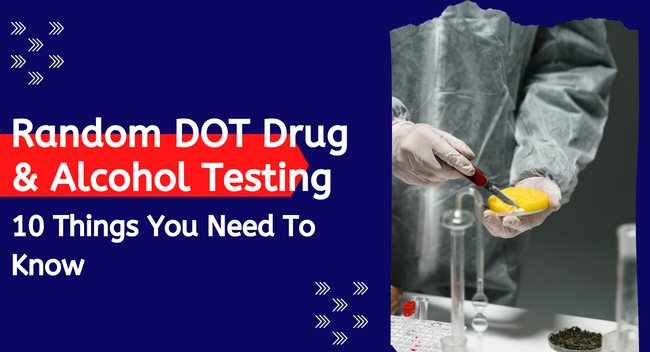
Everyone who is involved in the transport sector across the US needs to be aware of the DOT drug test and alcohol content assessment. The random dot drug and alcohol testing is regulated by the government. The department of transportation is in charge of this random testing procedure. In the year 1991, Congress came up with the Omnibus transportation employee testing act. The act recognized the need to ensure that the transportation industry is free of any drug and alcohol use and abuse.
According to this act, the DOT agencies were required to implement a drug and alcohol testing process for all the employees that handled safety-sensitive jobs. This was done to maintain the safety of the public, the people traveling, workers, employees, associates, and everyone involved in the transportation sector. The testing procedures are upheld to this date after having gone through a lot of amendments, changes, modifications, and upgrades.
1. Do I Need To Get A DOT Drug Test?
This is a question a lot of players in the transport industry ask. Remember that if you have an employee or worker that is designated in the DOT regulations as a safety-sensitive employee, he or she will be subject to the DOT drug and alcohol testing procedure.
If you are a safety-sensitive employee or if your company has several safety-sensitive positions, it means that the individual or the job is going to have an impact on the safety of everyone involved in your company and the public in general as well.
2. Let’s Have A Look At A Few Safety-Sensitive Positions Across Sectors And Departments
Federal Aviation Administration
- Flight attendants
- Crew members
- Aircraft dispatchers
- Ground security personnel
Federal Motor Carrier Safety Administration
- All commercial driver’s license holders
- Commercial motor vehicle operators
- Operators of vehicles that transport hazardous materials
US Coast Guard
- Crew members operating commercial vessels
Pipeline And Hazardous Materials Safety Administration
- Operations and maintenance personnel
- Emergency response workers
Federal Railroad Administration
- Engine and train workers
- Hours of service act personnel
- Signal service workers
- Train dispatchers
Federal Transit Administration
- Vehicle operators
- Mechanics and controllers
- Armed security and similar personnel
3. Understanding What DOT Drug Tests Comprise
All DOT drug tests typically use the same five-panel process. They usually test for the following:
- Marijuana metabolites/THC
- Cocaine metabolites
- Acetamides including MDMA and methamphetamine
- Opioids, which can include codeine, heroin, morphine, oxycodone, hydromorphone, and oxymorphone
- PCP
It depends entirely on the employer whether he wants to include more drug tests and test for other substances as well or not.
Understanding The Standard 5-Panel Drug Test
As pointed out above, this test is going to check for the aforementioned substances. The kind of tests performed can depend on the policies of the company. The employer may choose to go for more extensive tests based on the degree of safety and discipline that they want to maintain in their organization. Breathalyzers are usually used for alcohol testing and to ascertain the blood alcohol concentration in an individual. There are urine tests and hair sample tests as well that can be performed to facilitate more advanced testing and produce far more accurate results.
4. Situations Under Which Safety-Sensitive Employees Are Required To Get The DOT Drug Test Done
Pre-Employment
This is a very common testing procedure that every potential employee or candidate must go through. It is carried out before the employee is hired for a safety-sensitive position.
Reasonable Suspicion
Reasonable suspicion is when a trained supervisor in your company has reason to believe or suspects that some of your safety-sensitive position holders might be under the influence of alcohol or restricted substances or drugs. These tests are based on observations regarding behavior, speech, appearance, conduct, and other aspects.
Random Testing
The most popular form of drug and alcohol testing is the random DOT testing procedure. This is a completely random selection process in which each of your employees is covered. They are given an equal chance to get tested and this procedure is carried out quarterly to ensure the safety of everyone working in your organization.
Return To Duty
Return to duty testing is performed when an employee violates drug and alcohol rules at the workplace. This test is performed when they are about to return to their safety-sensitive job. These tests are conducted under direct supervision.
Follow Up
Follow-up testing procedures are done after the return to duty test. A substance abuse professional is going to manage the follow-up testing routines for up to 5 years.
Post-Accident Testing
Post-accident testing is mandatory if any of your employees is involved in an accident due to not being able to meet the criteria laid down by the department of transportation. They have to go through an alcohol test within 8 hours of the accident and then a drug test within 32 hours of the accident.
5. Failing Your DOT Drug Test – What Happens Next?
There are chances that you might fail your DOT-regulated drug and alcohol test. This does not mean that you have done anything wrong. The readings could be incorrect and that could be completely due to the negligence of the individual performing the tests or even due to some prescription medications that you might be taking. In any case, if you fail your DOT drug test, you will be required to step down from your safety-sensitive position. You can apply for a retest or a re-assessment of your samples.
However, if you are found to be under the influence of drugs and if there is enough reason to believe that you have broken any DOT-related rules and regulations and the workplace, you may face several serious consequences. You could lose your certificate or license. However, all of this is also going to depend on the policy of the company and your employment agreement.
6. The Role Of The Medical Review Officer
A medical review officer is then appointed to assess the result one more time to give his final verdict. If it is not a false positive, your employment may get terminated. The next step will be appointing a substance abuse professional who is going to recommend treatments and various remedial actions. He is also going to perform a follow-up test and assist you with an after-care regimen as well. You will then have to go through a return to duty test followed up by a follow-up test.
7. Advance Notice For Drivers And Safety-Sensitive Position Holders
This is highly unlikely contrary to what many safety-sensitive position holders might believe. Both random dot drug and alcohol testing and follow-up testing procedures are and should be performed unannounced. The driver gets a notification of the test and he or she must appear for it immediately as required in 382.305(I). If the individual or personnel is in the middle of performing a safety-sensitive function, he or she is required to cease that operation and proceed to the testing facility as soon as possible.
8. The Minimum Random Drug Testing Requirement Every Year
The federal motor carrier safety administration has set a minimum random drug/alcohol testing requirement for every year. This stands at 50% of the average number of safety-sensitive or driver position holders in your company for drug assessments. The minimum for random alcohol testing stands at 10%. In any of the cases, if there are any changes in the percentage, the same is going to reflect in the federal register.
9. Reporting All Positive Drug And Alcohol Test Results To The Government
As an employer, it is your duty and responsibility to report all positive drug and alcohol tests to the government. Any FMCSA violations should be reported to the CDL drug and alcohol clearinghouse. The details of a positive drug test could include:
- Confirmation about the alcohol concentration which should be at least .04 or more than that
- Refusal to test scenarios if any
- Actual knowledge about drug and alcohol abuse
- Return to duty test negative
- Completion of All the follow-up tests
- Driver admission of use and abuse to the medical review officer
- Submissions of violations made by the medical review officer
- Verified positive results submitted by the MRO
10. Refusing To Appear For A Drug Or Alcohol Test – What Are The Consequences?
If you have any driver or any safety-sensitive position holder who has refused to appear for a drug or alcohol test, they must be treated the same as if they have failed the test. They must be removed from the safety-sensitive function immediately and that includes driving responsibilities too. They must be directed to all the resources available to resolve their alcohol and drug problems. You will then have to direct them to take a return to duty test followed up by other relevant testing procedures and assessments.
Conclusion
You must remember that following all the rules laid down by the department of transportation and the federal motor carrier safety administration can be quite overwhelming. It is not practical for every transport company to keep themselves updated on the recent and the most critical developments that have taken place in the industry. It is not possible to follow each and every new rule and requirement that is issued by either of these bodies. This is why it is advised to associate with a dependable, skilled, and highly experienced third-party administrator. Yes, a reliable DOT compliance facilitator is a great way to stay compliant and in business for years to come.




0 Comments