Blogs

April 17, 2022

Simplifying Trucking with Unified Carrier Registration

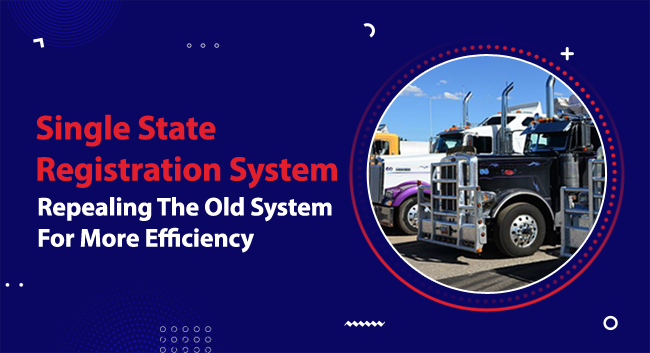
There was a time when the Single State Registration system was applicable. The same has been replaced by the Unified Carrier Registration program as the UCR.

Let’s Have A Look At The History Of The Single State Registration Program

For any carriers that intend to cross state lines, there was the Single State Registration System in place. It was referred to as SSRS. It was a widely used system where the home state of the carrier provided proof of liability insurance to all the other states across the country. This process was called the SSRS process. The insurance company of the carrier submitted the insurance information form to the home state of the carrier. They were not required to mail the insurance form to every state that they traveled to or through. The carrier was required to register only with its home state. This is why it was called the Single State Registration program.

Understanding Proof Of Insurance

When the single state registration program was not in place, proof of liability insurance usually reached every state through the insurance company. The carrier would register all their trucks with every state that they decided to travel through. After the completion of the registration process, each state would send over bingo stamps valued at $5 or $10. These stamps would be kept in the bingo stamp holders and each truck would require carrying them.

This procedure was becoming rather repetitive and very much time-consuming. Therefore, one fine day, the Single State Registration System was established. The stamp holders were discarded.

What Was The Bingo Card Program? 

Although obsolete right now, this was once a somewhat efficient system of registering motor vehicles that were involved in interstate commerce. These motor carriers needed to sign up for this system to prove that they possessed enough and the proper operating authority to operate across state lines and they had adequate auto liability insurance as well. The identification stamps were popularly known as bingo stamps and every state had them. In whichever state the motor carrier operated, the stamps were available and every vehicle that was able to fulfill the requirements of the state was given those stamps. Most of them were affixed to a cab card that the motor vehicle or the carrier was required to carry on them at all times. 

Challenges With The Single State Registration Program

It was after a few years of operation that certain problems began arising with this system. Officials and trucking companies noted a lot of loopholes with this program. This is when the Unified Carrier Registration program was introduced. Now that the single state registration system was not active, there was no charge that the carriers had to pay for their truck or tractor every year for each state that they traveled through.

Understanding The Unified Carrier Registration System

The current system is the UCR which is the Unified Carrier Registration program that has replaced the old Single State Registration System. Under this, carriers have to pay a flat rate every year on their trucks, tractors, and trailers that cross state lines regularly. They do not have to pay for each state that they travel through. It is just a one-time payment and they can make it once a year and can travel anywhere across the United States.

FAQ

Who Needs a USDOT Number?

Businesses that run commercial vehicles weighing more than 10,000 pounds—whether carrying passengers or moving freight—are required to register with the FMCSA and obtain a USDOT number. This number serves as a unique identifier that allows federal regulators to track and review a company’s safety records.

How Much Does a USDOT Number Cost?

Acquiring a USDOT number is free when processing with the FMCSA. For a hassle-free process with one-on-one assistance, visit: https://dotcompliancegroup.com/usdot-number-application-form/ or call 972-232-2218.

What Documents and Information Are Required?

To obtain a USDOT number, you will need to provide your business and operational details and identification. This includes legal business name, physical and mailing address, contact information, EIN number and/or SSN, type of business, cargo/cargo type, and operating authority.

How Long Does It Take to Get a USDOT Number?

Applying for a DOT Number can be done as fast as a few minutes. To obtain your DOT number today, visit: https://dotcompliancegroup.com/usdot-number-application-form/ or call 972-232-2218.

What if I renewed my UCR with DOT Compliance Group last year?

If you renewed with us last year, please check your Customer portal. If auto-renewal is still active, your UCR will automatically renew. If you have turned off auto-renewal, you’ll need to submit your renewal here on this page.

If I Pre-Register for 2026 UCR, when will I be charged the total amount?

The total amount will be charged on October 1, 2026 for the 2026 year.

I am an Ag Exempt Farmer. Am I exempt from registering for UCR?

No, if you cross over state lines you are required to register for UCR. Your Ag exemption does not apply to UCR.

If I am an Amazon or Postal Service Contractor do I have to register for UCR?

Yes. Even though you do not cross state lines, your parcels do. That makes you an Interstate carrier and you would be required to register at the 0-2 fleet size.

Who is Exempt from UCR?

Private Motor Carriers of Passengers and All Motor Carriers operating solely within Hawaii, except those involved in moving household goods for individual shippers.

What states do not currently participate in UCR?

Currently Arizona, Florida, Hawaii, Maryland, Nevada, New Jersey, Oregon, Vermont, Wyoming, & the District of Columbia are non-participating states. (This information is current as of 6-16-2023. For the most up-to-date information check the FMCSA website.)

If my base state is a non-participating state that means UCR does not apply to me, correct?

No, if you operate as an interstate carrier and cross into a state that does participate, then you are required to register with UCR.

Who must comply with DOT regulations?

Any business operating a Commercial Motor Vehicle (CMV) with a USDOT number is required to comply with DOT regulations. This requirement applies to motor carriers, freight forwarders, brokers, and companies operating under a hazardous materials permit.

What documents are required for a DOT audit?

Documents required during an inspection include but may not be limited to:

  • State driver’s license or commercial driver’s license
  • Medical examiner’s certificate
  • Record of duty status
  • Vehicle registrations
  • Periodic inspections document for all vehicles being operated
  • Shipping papers or bills of lading
  • Information for hazardous materials being transported
  • Proof of insurance

How can companies avoid common DOT violations?

Companies can avoid common DOT violations by maintaining accurate records, including driver logs, vehicle inspections, and required documents. Regular vehicle maintenance and pre-trip inspections help prevent safety-related violations. Proper training ensures drivers follow Hours-Of-Service rules, secure cargo correctly, and meet CDL and medical requirements. Using technology like ELDs and fleet management software can streamline compliance and reduce the risk of penalties.

What happens during a DOT compliance review?

During a DOT compliance review, or audit, officers review both the vehicle and the driver to ensure compliance with federal and state regulations. They check registration, insurance, inspection reports, and inspect safety equipment and vehicle systems for proper operation. Drivers’ licenses, medical cards, hours-of-service records, and logbooks or ELDs are also examined. The inspection helps identify violations and ensure safety on the road.

0 Comments

Submit a Comment