Blogs

July 22, 2022

OOS Corrections: Navigate Compliance Effectively

1. What Does OOS Mean?

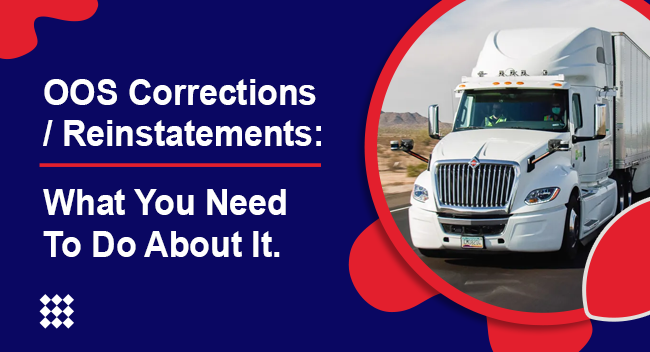
OOS stands for out of service order. So, If your vehicle is found to have violated or violates any roadside inspection conducted by an officer, as a result, you will be rendered or put out of service.

2. What Does Out-Of-Service Order Mean?

You will receive an out-of-service order if an authorized enforcement officer or federal or state body officer or someone authorized belonging to a local jurisdiction has declared that you are not fit for commuting on public roadways using your commercial vehicle.

Your commercial motor vehicle will be put out of service and you’ll not be allowed to carry out any operations under 49 CFR Sections 386.72, 390.5, 392.5, 395.13, 396.94, or any other compatible law.

3. What Are The Out-Of-Service Criteria?

There are certain critical vehicle inspection items that are considered the criteria for an out-of-service order.

These can prohibit the motor carrier or the driver from operating their commercial motor vehicle for a specified period of time.

It also means that they will not be able to operate unless the enforcement officer or the authorities allow them to do so. This will only be possible when they make the corrections with their OOS.

4. What Are The Levels Of Inspection For OOS?

In total, there are 6 levels of inspection for an out-of-service order. The enforcement officer is going to perform these 3 levels out of a total of 6.

Level 1

This is the most comprehensive inspection. The driver will be required to get their documentation, conduct, and vehicle examined and inspected by the enforcement officer.

Level 2

This level of inspection is almost identical to the level 1 inspection. The inspector is going to perform a walk-around of the vehicle for an extensive overview of the automobile.

Level 3

The level 3 inspection is a driver-only inspection. The officer is going to examine the driver’s records thoroughly including their daily logs and any vehicle inspection report as well.

5. How Do I Prevent A DOT Out Of Service?

If you want to stay away from any such order, the only way to do that is to ensure preventive maintenance of your vehicle.

One of the most common reasons that you might end up with an OOS order is a lack of regular upkeep. Remember to go for preventive vehicle maintenance every 6 months or as frequently as required.

This will help you stay away from any out-of-service orders. Even if you are pulled up by the enforcement officer more frequently. as compared to other drivers on the highway. When you take care of your vehicle, you have nothing to worry about.

6. What Is The Most Common Reason For Vehicles To Be Out Of Service?

There are a lot of reasons that can put you out of service. The biggest and the most common reason is improper vehicle maintenance. Some drivers have also noticed that an oil leak can cause the movement of the vehicle to get restricted.

You will receive an out-of-service order unless you make the necessary corrections and repairs. The same applies to your lights, brakes, tires, and other components that need regular repairs and maintenance.

7. What Can Happen If You Violate An Out-Of-Service Order?

It is not advisable to drive a vehicle that already has an OOS violation on it. So, It is to be remembered that the violations are civil, and the fines and penalties can be substantial. 

The driver can get disqualified from driving a commercial motor vehicle for any period of time. So, The fine for the driver can range anywhere from $2,500 to $5,000. There are surcharges and other penalties as well.

8. What Is The Most Common Dot Violation?

  • Operating a CMV without a commercial (appropriate) driver’s license (CDL)
  • Electronic logging device (ELD) – No record of duty status (RODS)
  • False report of driver’s RODS
  • No RODS present when one is required
  • Driver failing to retain previous seven days’ RODS
  • Does not have a valid operator’s license 
  • Driver physically unqualified
  • Driver operating a CMV without proper endorsements 
  • Operating a property-carrying vehicle with no valid medical certificate

9. What Are Driver OOS Violations?

Driver OOS violations are infractions such as driving under the influence of a substance or driving without a license or with a revoked license.

So, If you drive with an expired medical card or after your hours of service, it will be a driver OOS violation.

10. How Much Does OOS Correction Cost?

Finally get in touch with your third-party administrator to get more info on that.

FAQ

Who Needs a USDOT Number?

Businesses that run commercial vehicles weighing more than 10,000 pounds—whether carrying passengers or moving freight—are required to register with the FMCSA and obtain a USDOT number. This number serves as a unique identifier that allows federal regulators to track and review a company’s safety records.

How Much Does a USDOT Number Cost?

Acquiring a USDOT number is free when processing with the FMCSA. For a hassle-free process with one-on-one assistance, visit: https://dotcompliancegroup.com/usdot-number-application-form/ or call 972-232-2218.

What Documents and Information Are Required?

To obtain a USDOT number, you will need to provide your business and operational details and identification. This includes legal business name, physical and mailing address, contact information, EIN number and/or SSN, type of business, cargo/cargo type, and operating authority.

How Long Does It Take to Get a USDOT Number?

Applying for a DOT Number can be done as fast as a few minutes. To obtain your DOT number today, visit: https://dotcompliancegroup.com/usdot-number-application-form/ or call 972-232-2218.

What if I renewed my UCR with DOT Compliance Group last year?

If you renewed with us last year, please check your Customer portal. If auto-renewal is still active, your UCR will automatically renew. If you have turned off auto-renewal, you’ll need to submit your renewal here on this page.

If I Pre-Register for 2026 UCR, when will I be charged the total amount?

The total amount will be charged on October 1, 2026 for the 2026 year.

I am an Ag Exempt Farmer. Am I exempt from registering for UCR?

No, if you cross over state lines you are required to register for UCR. Your Ag exemption does not apply to UCR.

If I am an Amazon or Postal Service Contractor do I have to register for UCR?

Yes. Even though you do not cross state lines, your parcels do. That makes you an Interstate carrier and you would be required to register at the 0-2 fleet size.

Who is Exempt from UCR?

Private Motor Carriers of Passengers and All Motor Carriers operating solely within Hawaii, except those involved in moving household goods for individual shippers.

What states do not currently participate in UCR?

Currently Arizona, Florida, Hawaii, Maryland, Nevada, New Jersey, Oregon, Vermont, Wyoming, & the District of Columbia are non-participating states. (This information is current as of 6-16-2023. For the most up-to-date information check the FMCSA website.)

If my base state is a non-participating state that means UCR does not apply to me, correct?

No, if you operate as an interstate carrier and cross into a state that does participate, then you are required to register with UCR.

Who must comply with DOT regulations?

Any business operating a Commercial Motor Vehicle (CMV) with a USDOT number is required to comply with DOT regulations. This requirement applies to motor carriers, freight forwarders, brokers, and companies operating under a hazardous materials permit.

What documents are required for a DOT audit?

Documents required during an inspection include but may not be limited to:

  • State driver’s license or commercial driver’s license
  • Medical examiner’s certificate
  • Record of duty status
  • Vehicle registrations
  • Periodic inspections document for all vehicles being operated
  • Shipping papers or bills of lading
  • Information for hazardous materials being transported
  • Proof of insurance

How can companies avoid common DOT violations?

Companies can avoid common DOT violations by maintaining accurate records, including driver logs, vehicle inspections, and required documents. Regular vehicle maintenance and pre-trip inspections help prevent safety-related violations. Proper training ensures drivers follow Hours-Of-Service rules, secure cargo correctly, and meet CDL and medical requirements. Using technology like ELDs and fleet management software can streamline compliance and reduce the risk of penalties.

What happens during a DOT compliance review?

During a DOT compliance review, or audit, officers review both the vehicle and the driver to ensure compliance with federal and state regulations. They check registration, insurance, inspection reports, and inspect safety equipment and vehicle systems for proper operation. Drivers’ licenses, medical cards, hours-of-service records, and logbooks or ELDs are also examined. The inspection helps identify violations and ensure safety on the road.

0 Comments

Submit a Comment