
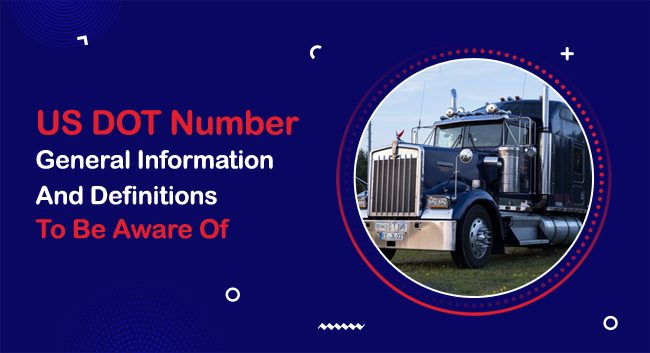
US DOT Number – A Definition
Your US DOT number is a number issued by the United States Department Of Transportation. There are a few commercial vehicles such as pickup trucks, trucks, vans, semi-tractors, vehicles that transport passengers, and other automobiles involved in commercial activities that get affected directly by the US DOT number requirements.
In other words, if your company or business uses any vehicles for commercial purposes, that have a gross vehicle weight rating stamped on their frame showing 10,000 LBS or more, will be required to be registered for a US DOT number. Likewise, if you have a combination of a powered vehicle and a trailer that has a gross combination vehicle weight rating of 10,000 LBS or more, or is being used as a vehicle to transport passengers will also be required to Register for a US DOT number. According to the rules being followed in a few states across America, any such vehicle as described above must be registered for a US DOT number even when operating exclusively within the borders of the said states.
The Regulation
The federal motor carrier safety administration regulations part 390.5 defines commercial motor vehicles. It is done to make sure that these vehicles are compliant with the US DOT marking requirements 390.21 and can be understood as follows:
Any self-propelled motor vehicle will be categorized as a commercial motor vehicle if:
- It is being used on public roads and highways
- Its gross vehicle weight rating or gross combination weight rating is 10,000 lbs or above
- The vehicle is designed to transport 8 passengers or more including the driver (for compensation)
- The vehicle is designed to transport 16 people or more including the driver (but not for compensation)
- The automobile is being used to transport hazardous materials in certain quantities that it necessitates for the vehicle to be placarded
Note: Any vehicle that transports hazardous materials will not be subject to any weight stipulations. It can have any weight if it is transporting materials in quantities that require placarding in the first place and this applies to both intrastate and interstate operations.
- It is a towed vehicle used for interstate commerce as well as to transport property or passengers
Understanding Semi-Tractor/Truck Operations Associated With DOT Number Registrations
- You will need a US DOT number if you are a private carrier service hauling your own products across state lines. If the gross vehicle weight rating of that automobile is 10,000 LBS or above, this will apply to you. If the gross weight or combined gross weight exceeds 26,000 lbs when the vehicle crosses the state line, you will have to register for an IRP license plate, IFTA Fuel Tax, and Unified Carrier Registration.
- You will need an employer identification number if the gross vehicle weight rating of the vehicle exceeds 54,999 lbs. You will also have to file the annual 2290 Federal Highway Use Tax. If your vehicle, it can be a semi-tractor, truck, or a trailer, weighs 60,000 lbs or more, and if you are crossing into Kentucky, you will be required to preregister for a Kentucky KYU Number. If your vehicle crosses into New Mexico or Oregon, you can pay the Port Of Entry or may decide to pre-register with these states for your Weight Distance Tax.
- You will need ICC Authority /DOT Authority or Trucking Authority / MC Number or ICC Number/ICC Carrier or Truck Authority /Operating Authority if you intend to haul loads for any pay across state lines that require a Motor Carrier Permit.
- In case of a “leased to a trucking company” that works with a straight truck or semi-tractor as an owner-operator vehicle weighing above 26,000 lbs, you will have to register for US DOT number. The US department of transportation classifies you as a registrant and not a carrier. Whenever you decide to cross state lines, you will have to get an IRP license plate. Most trucking companies across the states provide IFTA Fuel Tax stickers and cab cards. You may apply for them on your own if your company does not do that. If the gross vehicle weight rating of your vehicle exceeds 54,999 lbs, you must register for an Employer Identification Number and will have to file for the Annual 2290 Federal Highway Use Tax as well.
- Your exempt loads can be hauled across state lines. Loads that require a motor carrier number or permit can also be taken across state lines but for that, you will have to register for Interstate Authority/Federal Highway Authority, ICC number or ICC MC Number, FMCSA authority, or ICC Permit (they all mean the same). Remember the Unified Carrier Registration as well.
- You will have to register for a US DOT number if you haul exempt products such as logs, livestock, and grain. If you operate a “for-hire” vehicle with a gross vehicle weight rating of 10,000 LBS or more, you need to comply with this requirement. You will need an IRP license plate if the vehicle weight exceeds 26,000 LBS while you are crossing state lines. When transporting exempt commodities, you will be classified as a carrier and you will need IFTA fuel tax as well as unified carrier registration. If the vehicle gross vehicle weight rating crosses 54,999 LBS, you will have to register for an Employer Identification Number along with 2290 Federal Highway use tax filing. You must register for proof of liability insurance in certain states according to their rules and regulations. Other documents that you will have to register for include Motor Carrier Number, ICC filing, Interstate Trucking Authority, ICC MC Authority, Federal Transportation Authority, or DOT US Authority.
- In case you already have ICC authority or DOT authority and your gross weight exceeds 26,000 lbs, you will be required to have a DOT number/US DOT number in addition to an IRP license plate, IFTA Fuel Tax, and Unified Carrier Registration. This applies to you if you are going to apply for a Motor Carrier Number, ICC Interstate Authority, Interstate Trucking Authority, or DOT MC Number, or ICC Motor Carrier Authority.
- If you are a farmer working with a straight truck or a semi-tractor with a farm plate but do not cross state lines, you are not required to register for a US DOT number. Farm plated trucks only haul livestock and other agricultural items. If the gross weight exceeds 54,999 LBS, you will be required to get an Employer Identification number along with 2290 Federal Highway Use Tax Filing.
- If you are hauling loads on a for-hire basis, you will be deemed as commercial and you will have to comply with state rules and regulations that apply to commercial operations. You will have to register for a commercial license plate and the state fuel tax if your semi-tractor weight exceeds 26,000 lbs. Hauling loads such as grain and livestock across state lines will necessitate you to apply for an IRP license plate, IFTA fuel stickers, and UCR. You may also have to apply for a Motor Carrier Number, ICC number, Trucking Authority, Absolute Trucking Authority, and ICC Carrier if you want to haul loads across state lines that require these permits.
- If you are a farmer crossing state lines with your truck, trailer, semi-tractor, with a gross vehicle weight rating of 10,000 lbs or above and a farm plate, you will be required to register for a US DOT number. If the gross weight of your vehicle exceeds 26,000 LBS, you will also be required to register for IFTA Fuel Tax and UCR. You must also obtain an Operating Authority, Federal Highway Authority /ICC number /ICC MC Number, ICC Permit/FMCSA authority, (all mean the same thing).




0 Comments