
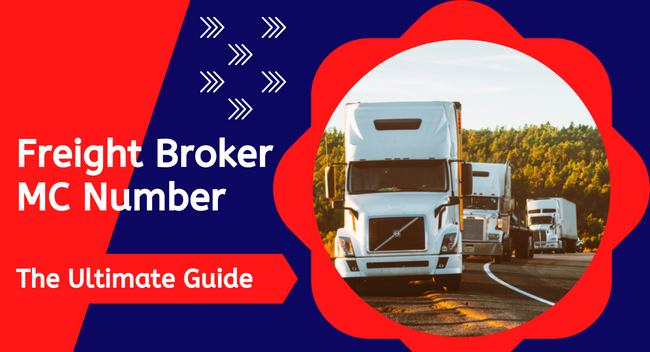
In the simplest of words, a freight broker MC number is the first step to getting your freight broker authority. If you are a freight broker, it means that you are an individual or a corporation that is involved in the transportation of property which excludes any household goods.
You receive payment for arranging the transportation of the property and you use an authorized motor carrier for this service. As a broker, you do not assume responsibility for the property. You do not take possession of the property either.
If you want to activate your broker authority, you must apply for a broker number which is your MC. You must also have a USDOT number and BOC3 list of process agents. In addition to this, you are also required to enroll in the unified carrier registration program. As an applicant, you must have $75,000 in a surety bond.
Understanding Broker Authority
If you obtain a broker authority license, it is going to allow your company to schedule and hire carriers for the transportation of cargo that belongs to third parties. These are the people who transport the cargo. If you apply for registration and all the information submitted by you checks out, you will receive your freight broker MC number.
Understanding The Various Requirements For Brokers
As a broker, you must register with the federal motor carrier safety administration. This is to handle financial liability coverage. As a broker, you will be required to keep all the information pertaining to financials, administration, and record keeping. You should not represent yourself as a motor carrier. You should not represent yourself as the custodial of the property either.
Types Of Brokers
1. Property Brokers
You will be considered a property broker if you are a sole individual or a singular corporation involved in the business of handling transportation of property. It should not encompass household goods. The transported goods are owned by others. You get paid to transport this property. As a broker, the property is not your responsibility. You are not allowed to have any possession of it either.
2. Household Goods Brokers
A household goods broker is an individual or a partnership company or a corporation that receives payment for the transportation of household goods that belong to third parties. You do not have any responsibility for these goods and you do not take possession of them either. Household goods are all the personal items and property used in a home. You must register as a household goods broker if you want to handle household goods.
Understanding Other Types Of Broker Authority
Primarily, there are two types of authorities that have been listed above. But there are numerous other authorities as well that you might want to obtain depending upon the industry niche you work in. You must choose the right authority and for that, you should assess the type of goods that you want to transport.
US-Based Enterprise Carrier Of International Cargo
It does not pertain to household goods. This applies to companies that ship international cargo. They must have their established headquarters in the US and may be controlled by a Mexican citizen or a resident alien by 55%. Either their cargo should originate from a country that is located outside of the US or the destination of the cargo should be outside of the US.
US-Based Enterprise Carrier Of International Household Goods
It pertains to household goods only. The rule is that a headquarters in the US and the rest are the same as mentioned above. The goods are categorized as household goods are personal items used in homes. Items shipped from factories and purchased for use in homes come under this umbrella. The homeowner is responsible for paying for the transportation charges.
- Freight Forwarder FF Number
- Non-North America-Domiciled Motor Carrier
- Mexican Certificate Of Registration For Foreign Motor Carriers And Foreign Motor Private Carriers
Applying For Your Freight Broker Authority
The ideal and highly preferred way is to go to your third-party administrator or consortium. It is a practical way to apply for your freight broker authority.
1. You Must Apply For Your USDOT Number First
You will need this number for several other applications as well.
2. Register With The FMCSA
You need to register with the federal motor carrier safety administration as well. You must fill out the OP-1 form to receive your MC number or FF number. The filing fee is $300.
3. You Can Apply For It In Three Ways Such As:
Online: To apply for it online, you must have a Credit Card. This method is faster than any other method.
Via Mail: Complete your OP-1 form and mail it to the address given on the form. Include the payment along with it.
By Phone: You can also request the form by calling on their toll-free number. It will get mailed to you soon and all you have to do is complete it and return it through the same method along with the payment. It can take up to 4 weeks for the process to complete.
4. Obtain A Surety Bond
The next step is to obtain a surety bond with a coverage of up to $75,000. This is going to protect you and your customers in the event that a shipper is unable to pay for your shipment. In such a situation, you as the freight broker will be responsible for the cost.
5. Designating Process Agents
You should designate a process agent within 90 days of receiving your MC or FF number.
6. Receiving Your License
It is time to receive your license. However, in the end, it is advisable and essential to note that you must get in touch with your third-party administrator or consortium to help you figure out the best and the fastest way to get your freight broker MC number or FF number. It is a safe and reliable way to stay DOT compliant throughout the year.




0 Comments